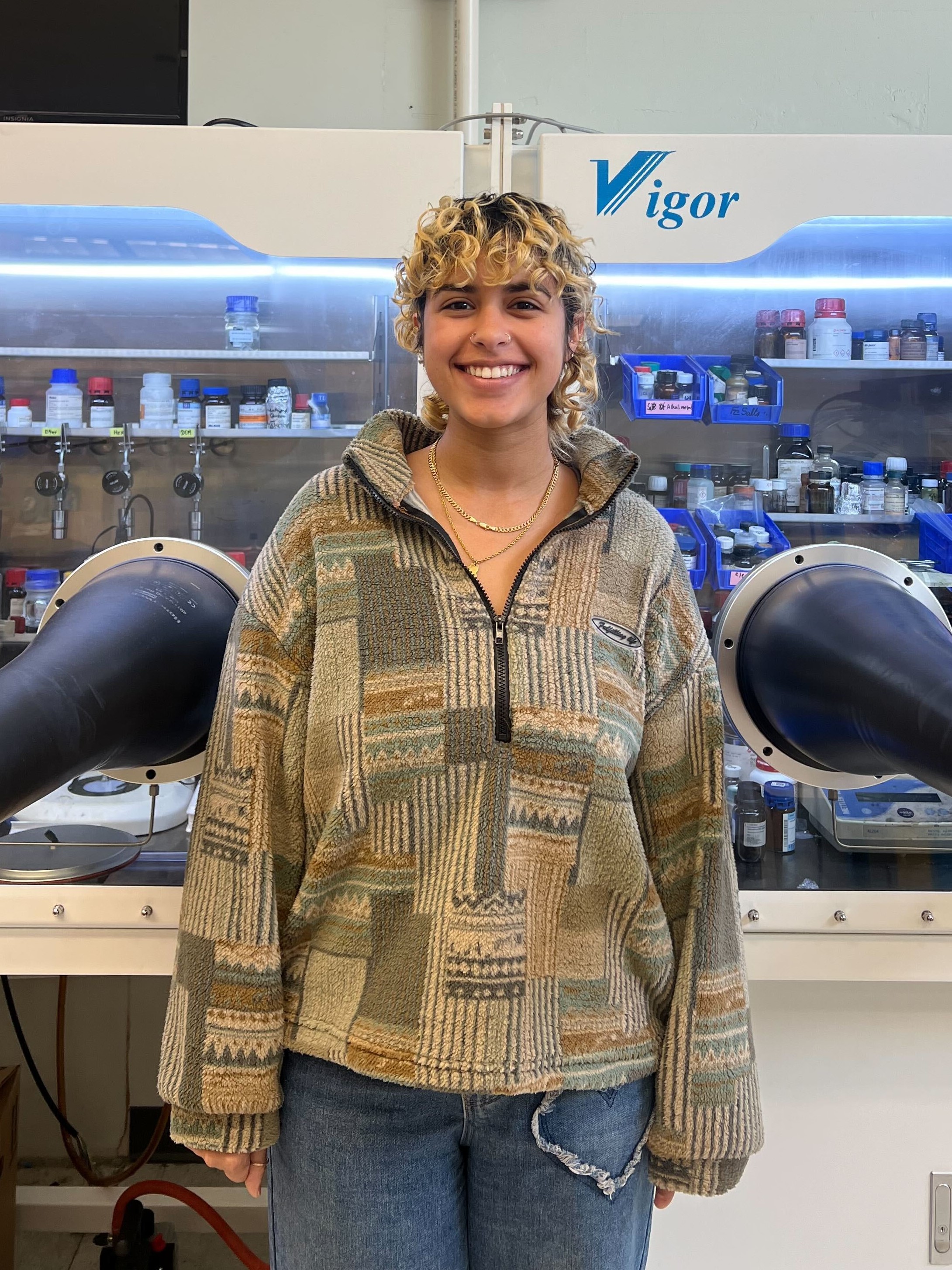
Graduate student Rachel Perez has been awarded the Dean's Award for Doctoral Excellence (DADE), a competitive honor that recognizes outstanding doctoral students in the FSU College of Arts & Sciences. The award provides up to three years of supplemental salary funding to doctoral students who have advanced beyond their second year in the graduate program. The DADE recognizes both Rachel's accomplishments to date and the promise of her ongoing dissertation research.
Rachel's research addresses one of the central challenges in the development of quantum technologies: building molecular electron-spin qubits that can hold a quantum state long enough to be useful. Molecules are appealing building blocks for qubits because their electronic structure can be precisely tuned through synthetic chemistry, but the fragile superposition states they encode are easily disrupted by magnetic "noise" from surrounding nuclear and electronic spins. Rachel's work targets this problem using spin clock transitions (SCTs), special points in a molecule's energy landscape where the qubit becomes insensitive to magnetic fluctuations, dramatically extending the time over which quantum information can be preserved.
Her project focuses on designing and measuring five-coordinate nickel(II) complexes in a trigonal-bipyramidal geometry, which adopt a spin state (S = 1) well suited to hosting these protected transitions. By systematically distorting the molecular structure—for example, by swapping the ligands in a family of [Ni(TAO)X] complexes—Rachel has been able to tune the size of the clock-transition gap, with the most distorted complex, [Ni(TAO)Br], yielding a gap of 290 GHz. To characterize these systems she has employed an impressive battery of advanced techniques, including far-infrared magneto-spectroscopy (FIRMS), electron paramagnetic resonance (EPR), inelastic neutron scattering (INS), and magnetic susceptibility measurements. Looking ahead, she plans to extend this work from single-qubit monomers to nickel dimers that could serve as models for two-qubit quantum gate operations. Congratulations, Rachel!
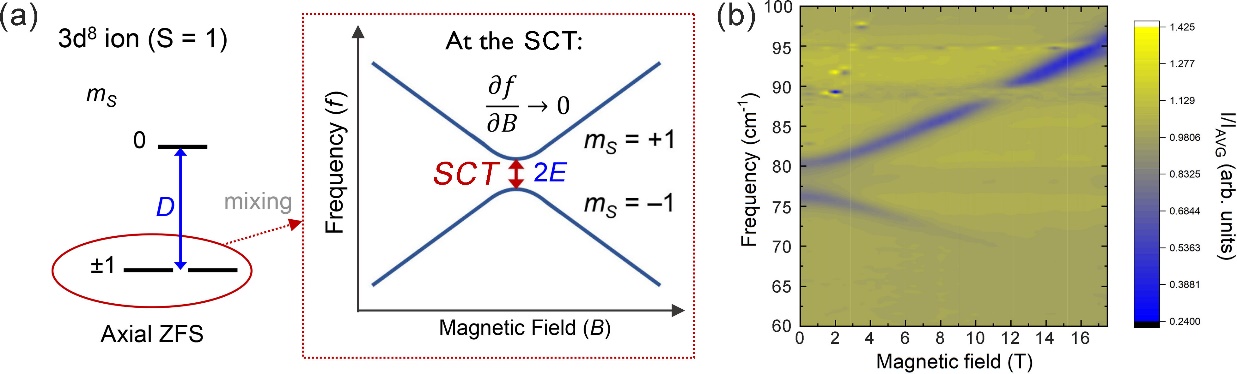
For a 3d8 ion (S = 1), axial zero-field splitting stabilizes the mS = ±1 substates, which mix to create a clock transition (SCT). At the SCT, the transition frequency becomes insensitive to the magnetic field (∂f/∂B → 0), protecting the qubit from magnetic noise (right: far-infrared magneto-spectroscopy data).
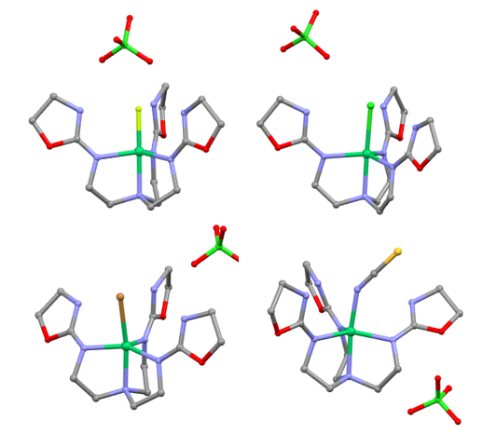
Structures of the [Ni(TAO)X](ClO4) complexes studied in this work, where X = F⁻, Cl⁻, Br⁻, and NCS⁻. Varying the axial ligand tunes the structural distortion and the size of the clock-transition gap.