CHEMISTRY
1030 Section 002 (37545)
General
Chemistry for Allied Health
Spring 2006
Course Information
Instructor: Dr. Stephanie R. Dillon Office: 347 DLC; Phone: 644-0166;
E-mail: dillons@tcc.fl.edu or sdillon@chem.fsu.edu
Office hours: F, 10:00AM- 11:00AM and by appointment
Blackboard Web Site: http://campus.tcc.edu
Lecture: Monday, Wednesday, and
Friday, 9:05AM - 9:55AM, SM 118
Course Materials: 1. Required Text -
M. M. Bloomfield and L. J. Stephens, Chemistry
and the Living Organism, 6th Ed., John Wiley & Sons, Inc.
1996.
3.
Required - You need a
scientific calculator that will perform exponential calculations in addition to
standard mathematical calculations. You
are expected to know how to use it and bring it to every class meeting.
The Objective for students in nursing,
nutrition and fitness, and other allied health areas to become familiar with
the general concepts of chemistry.
Stress will be placed on those concepts in chemistry that most strongly
relate to processes in health related sciences such as drug dosage, fluid
dynamics and pressure, radioactivity, etc.
For a detailed list of course objectives, please see the Science and
Mathematics division page - under Student Resources, Description of Division
Courses.
ATTENDANCE
Class
attendance is crucial to be successful in this course. I really want you to be here. Chemistry is cumulative; it builds on what
has come earlier in the course. If you
are absent, you will miss important new material, examples, assignments,
quizzes, or even tests. I will not
withdraw you from the course if you are absent or late. If you quit attending, do not assume you
have been withdrawn. The deadline for
you to withdraw yourself from this course and receive a “W” is Tuesday, February 9th. Withdrawal from a class is not the same as withdrawal from all classes, and they have different deadlines.
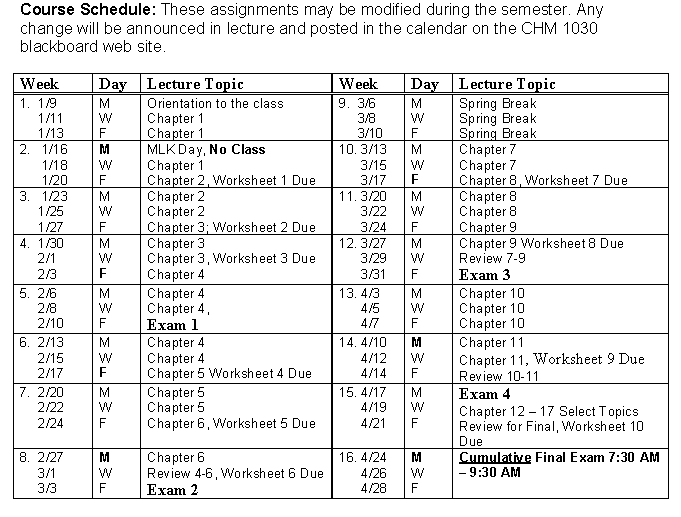
Problem Worksheets: Associated with each topic
will be a worksheet (10 points each) that will include chapter summaries
(written by the student), problems that we will work together in class, and
problems which the students will work on their own or in small study groups.
These exercises, as well as problems worked in lecture, are indicative of the
types of problems appearing on quizzes and examinations. Your worksheets will
be collected on assigned days (see calendar) and graded. Worksheets are available on the blackboard
website. It is the student’s
responsibility to download/print out the worksheet for each chapter. Please
understand that doing these exercises is essential to learning the course
material. You do not know if you have mastered a topic until you can solve
exercises about it on your own.
WRITING ASSIGNMENTS: All students enrolled in CHM 1030
are required to complete written assignments of 1000 words minimum. If submitted work is unsatisfactory in
either quality (college level writing) or quantity, the highest grade that can
be obtained in the course is a D. The
writing requirement will be met using an online writing program, Calibrated
Peer Review (CPR), which is described below.
The instructor will review students whose text receives a peer review
score of less than 5. If the writing is
considered below college level, the instructor may require the student to
submit a revised copy of the writing assignment.
Calibrated
Peer Review
Calibrated Peer ReviewTM (CPR) is an
Internet-based instructional tool that enables students to learn by writing
about important topics in a course. In
a CPR assignment, students write short essays on a specific topic. Guiding questions encourage critical
thinking and help students organize thoughts for the essay. After electronic submission of essays,
students read and assign a score to three “calibration” essays. Once students demonstrate they are competent
reviewers, they read and assign a score to three anonymous peer essays, and
finally, to their own essay. Regular
use of CPR assignments teaches students to articulate ideas coherently and to
critically evaluate both their peers’ and their own work.
Writing Assignments _____ _____ _____
Quizzes and Examinations: There will be a total of 6
quizzes given during the span of the course, they may or may not be
announced. Because the material
covered later in this course builds upon material covered earlier in this
course, the hour examinations are cumulative in their coverage of the material.
However, each hour examination will primarily focus on the material covered
since the previous exam unless otherwise noted in lectures. There will be
no make-up quizzes or make-up hour examinations. A quiz missed for any
reason will count as one of the low scores to be dropped (see below). An hour
examination missed for what will be deemed as a valid excuse will result in the
increase of the worth of the final examination by 100 points. If you have what
may be deemed a valid excuse for missing a quiz or an hour examination, provide
a copy of supporting documentation to the instructor. The final examination is
fully cumulative and will cover the entire course.
Grades: The course grade will be
based on the percentage of 1000 points earned according to the following
distribution:
A = 90 - 100% of the
points; B=80 -89%; C = 70 - 79 %; D = 60 - 69%; F =less than 60%. (This scale
represents the minimum grade to expect.)
|
Worksheets, 10 @ 15 each |
150 points |
|
Writing Assignments |
200 points |
|
Quizzes, best 5 of 6 @ 10
each |
50 points |
|
Exams, 4 @ 100 each |
400 points |
|
Final Exam |
200 points |
|
Total Possible Points |
1000 Points |
WRITING ASSIGNMENTS
All students enrolled in CHM 1030 are required to
complete written assignments of 1000
words minimum. If submitted work is
unsatisfactory in either quality
(college level writing) or quantity,
the highest grade that can be obtained in the course is a D. The writing requirement will be met using an
online writing program, Calibrated Peer Review (CPR), which is described
below. The instructor will review
students whose text receives a peer review score of less than 5. If the writing is considered below college
level, the instructor may require the student to submit a revised copy of the
writing assignment.
Calibrated Peer Review
Calibrated Peer ReviewTM (CPR) is an
Internet-based instructional tool that enables students to learn by writing
about important topics in a course. In
a CPR assignment, students write short essays on a specific topic. Guiding questions encourage critical
thinking and help students organize thoughts for the essay. After electronic submission of essays,
students read and assign a score to three “calibration” essays. Once students demonstrate they are competent
reviewers, they read and assign a score to three anonymous peer essays, and
finally, to their own essay. Regular
use of CPR assignments teaches students to articulate ideas coherently and to
critically evaluate both their peers’ and their own work.
Writing Assignments _____ _____ _____
Academic Alert
House Bill 1545, passed by the 1997 Florida Legislature, requires that students
enrolled in the same college credit course more than two times shall pay
non-resident fees for the third time attempted of the course. Florida colleges
and universities were required to start "counting" attempts beginning
Fall, 1997. An enrollment is considered a valid attempt if the course remains
on your schedule past the published college refund date. (A grade of W or AW
thus counts as a take.) On the third attempt not only do you pay non-resident
fees, but you may not withdraw from the course. Fourth attempts are allowed
only through an academic appeals process based on major extenuating
circumstances. All grades from the third and subsequent attempts will be
calculated into the grade point average.
Disability Student Support
If you require academic accommodation, you need (1) to register with Disability
Student Support (DSS) office in the student union (SU172) and provide
documentation, and (2) to provide a letter indicating the type of accommodation
needed. Please stop by my office during the first week of class so we can
work together to ensure the best possible learning environment.