News
Florida State / ABOUT US / NEWS

Curious Colours Expose f-electron Covalency Effects
New knowledge overwrites electronic structure assumptions surrounding actinide complexes
Victoria Posey and Ashley Arcidiacono receive the NSF Graduate Research Fellowship and honorable mentioned
FSU chemistry students have received a prestigious and highly competitive fellowship from the National Science Foundation.
Prof. Steinbock Organizes Symposium and Festschrift in Honor of Former Advisor
Dr. Steinbock co-organized a symposium on “The Interdisciplinary Impact of Nonlinear Chemical Dynamics” in honor of his former postdoctoral advisor Prof. Kenneth Showalter.
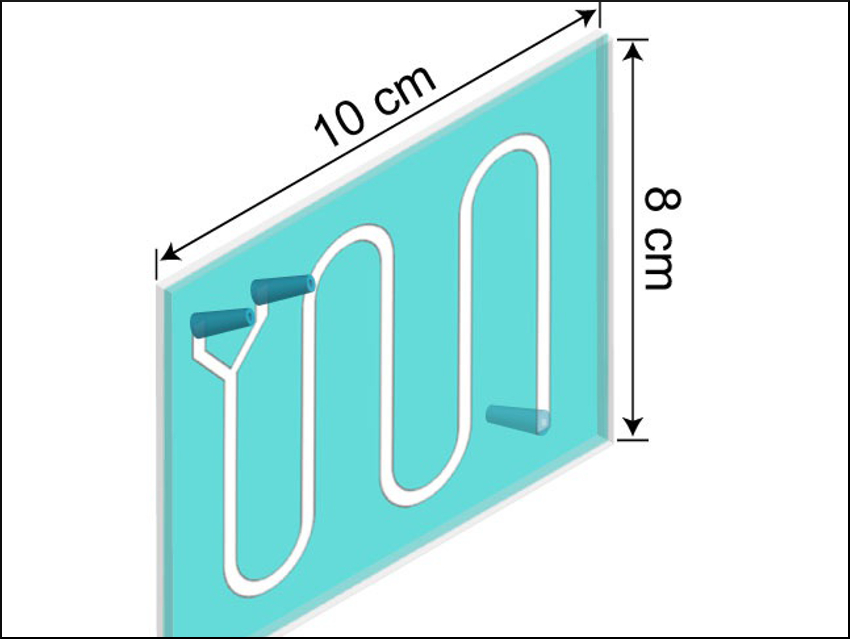
Mineral Membranes for Prebiotic Chemistry
Steinbock and colleagues use microfluidic devices to create mineral membranes from iron, calcium, manganese, cobalt, copper, zinc, or nickel compounds and test them for prebiotic reactivity.
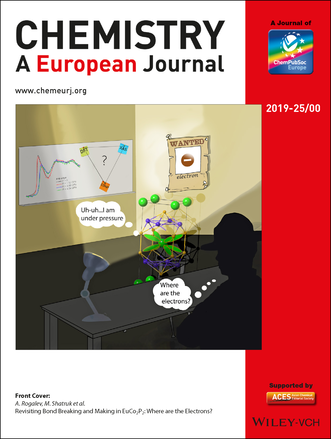
Cover Profile: Revisiting Bond Breaking and Making in EuCo2P2
Invited for the cover of Chemistry a European Journal,the groups of Michael Shatruk at Florida State University, Andrei Rogalev at the European Synchrotron Radiation Facility, and colleagues depict their work demonstrating that formal charges become inadequate when one deals with metallic systems with delocalized bonding.
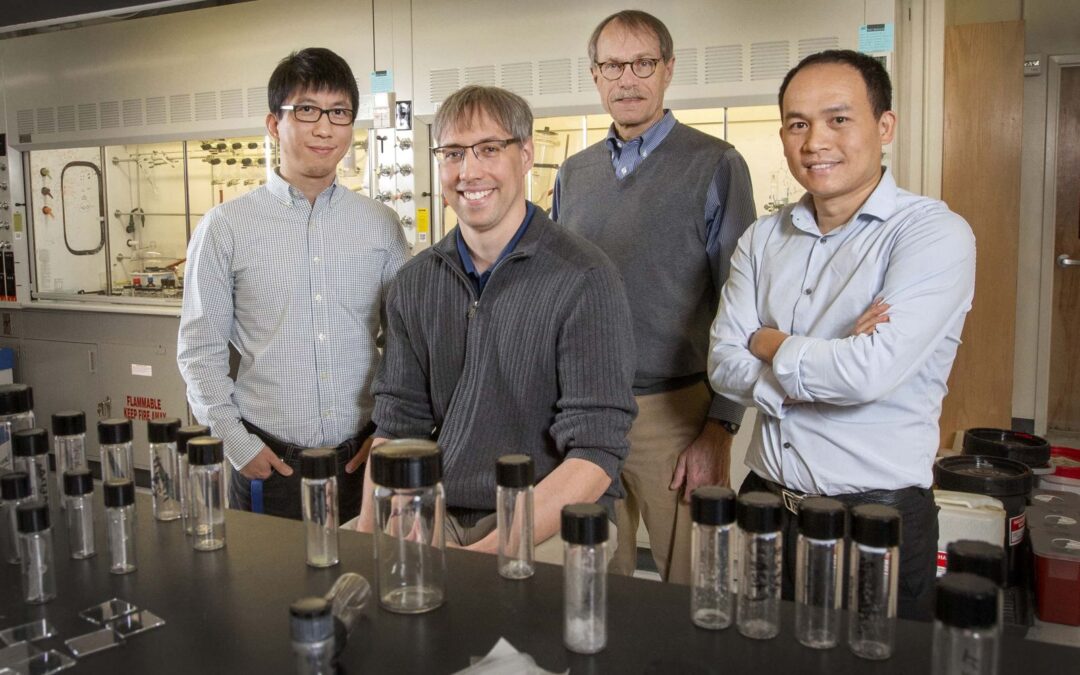
On the rise: Six years of scientific success
Florida State University researchers Biwu Ma, Kenneth Hanson and Hanwei Gao have a few things in common. Several things, actually.
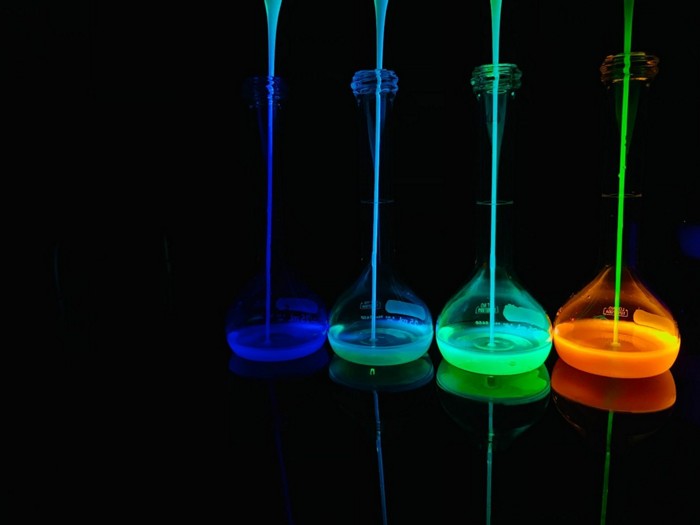
Chemistry in Pictures: All hail halides
C&EN Chemistry in Pictures showcasing emission from CsPbBr3 nanocrystals created by the Nienhaus group.
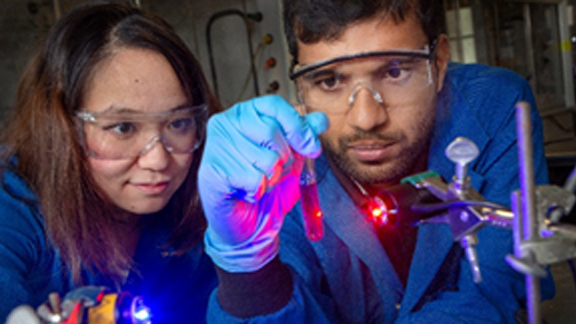
Lighting the Way to Removing Radioactive Elements
The Hanson research group performs a photochemical separation of ruthenium and iron using blue and red light, respectively.

Top-Down Mass Spectrometry in Clinical Diagnosis? A Potentially Less Invasive Approach for Plasma Cell Disorders Classification
The Marshall group has exploited 21 tesla Fourier transform ion cyclotron resonance mass spectrometry to benchmark top-down MS/MS de novo sequencing of M protein from serum.
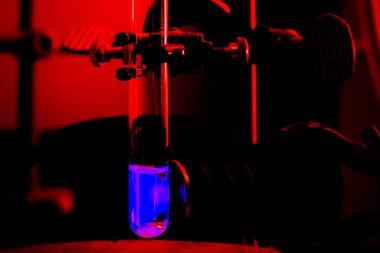
Light-activated chirality switch directs enantiomeric excess
FSU researchers use light to transform a racemic ligands into one of its enantiomers by way of excited state proton transfer.